
Pet Health Supplements ODT vs ODF: A Label-Reading Guide
ODT and ODF are delivery-format labels for pet health supplements, not therapeutic categories. ODT means Orally Disintegrating Tablet. ODF means Orally Disintegrating Film. In the Novohope product naming used in this guide, Pet Nutritional ODT and Pet Nutritional ODF sit in the product name, while labels such as cardiovascular, digestive, eye care, and weight management describe the intended nutritional support area. The format label tells a buyer what the product record calls the physical format. The function label tells a buyer what the formula is positioned to support. Confusing the two is the main reason oral fast-dissolving pet supplement listings look more alike than they are.
Novohope is a brand of functional pet supplements; its product series includes COAT+, EYES+, CALM+, BONE+, HEART+, PROBIO, and Fit+. This guide is educational and label-focused. It does not decide whether any supplement is right for a particular pet, and it does not turn a product label into veterinary advice. Its purpose is narrower: to show how to read ODT and ODF categories accurately, where the shared oral fast-dissolving matrix fits, and how function words appear across product models.
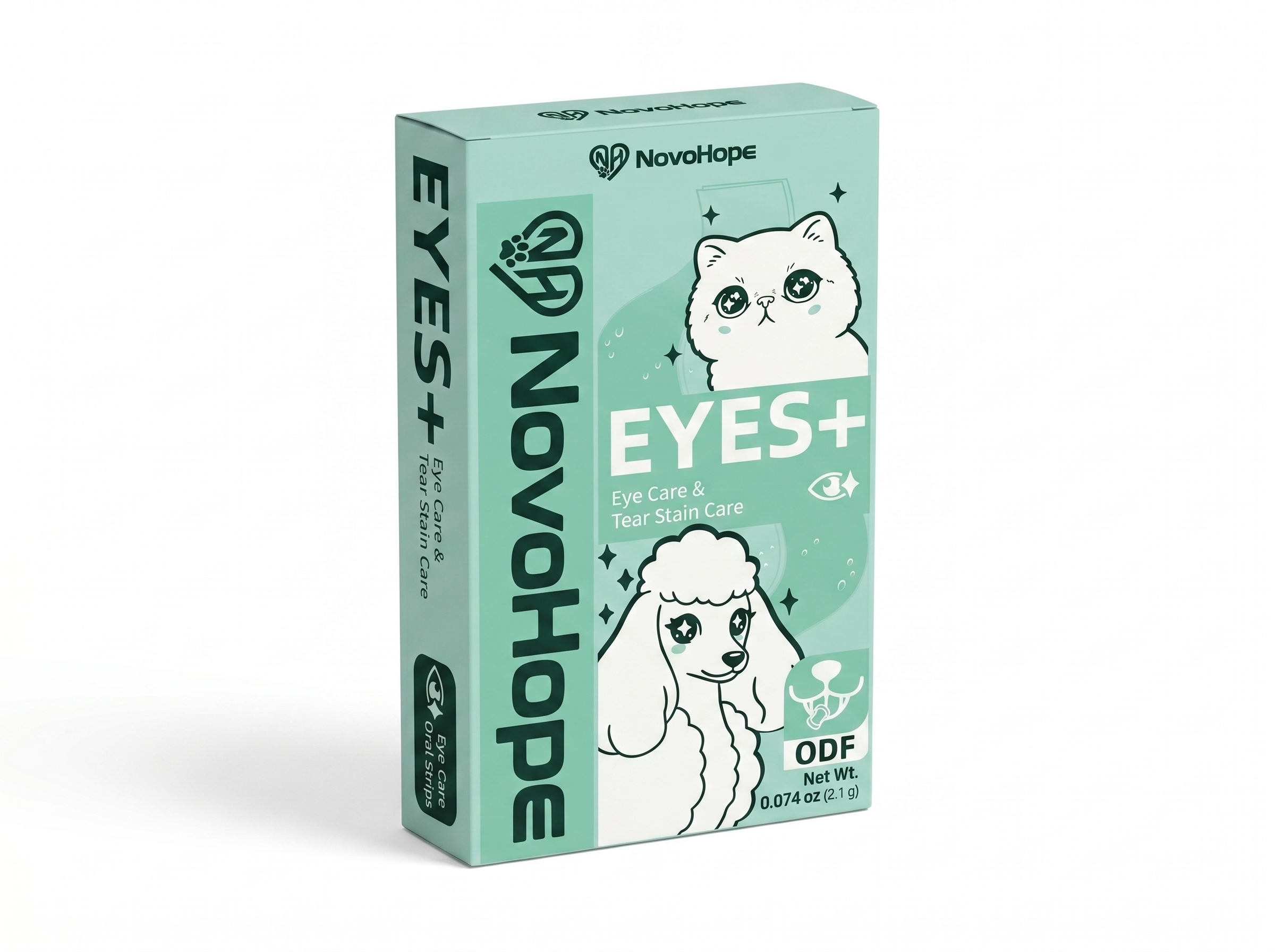
Why ODT and ODF are easy to confuse
The confusion starts with overlapping commercial language. A listing can call a product a pet health oral strip, oral dissolvable film, fast-dissolve film, or nutritional ODT. Some of these words describe a product family. Some describe a format. Some are broad search phrases. They are not interchangeable even when they appear in the same catalogue.
In the supplied product records, strip is used across both format groups. PROBIO, an ODT, is described with a specification of 2.5g per strip and 10 strips per pack. EYES+, an ODF, is also described with each strip weighing 2.1g. BONE+ is classified as a pet nutritional ODT and as a pet health oral strip. That means a buyer cannot rely on the word strip alone to identify ODT versus ODF. The explicit form field is the stronger signal.
Another source of confusion is the phrase Pet Supplement Oral Dissolvable Films. It is a broad category phrase that can cover more than one oral fast-dissolving format. Likewise, Pet Fast-Dissolve Oral Films sounds specific but may be used as an umbrella term. For label reading, the decisive question is not whether the product is fast-dissolving or oral. It is whether the form field says ODT or ODF.
Label-reading rule: read the form field first, the matrix statement second, the functional category third, and the model specification fourth. Do not let a broad phrase such as oral strip replace the form field.
Industry background: why format labels matter now
Global Market Insights reported the pet supplement market at USD 7.5 billion in 2025 and projected USD 7.95 billion in 2026. That market context does not by itself validate any format claim, but it explains why buyers see more delivery-format language in pet health supplements. As brands look for formats that fit feeding routines, oral fast-dissolving products appear alongside powders, tablets, and chews. The category question becomes practical: when a listing says ODT, ODF, oral strip, or fast-dissolve film, what exactly is being described?
The industry data also shows why claim discipline matters. A 2025 manufacturer article from Wuhan Jinglong Biotechnology states 98% absorption for oral dissolving films, while Novohope product material describes a claimed 95% absorption rate for its oral film products. Both figures are manufacturer-reported and product-context-specific. They should be read as claims to compare, not as a single industry standard for every ODT and ODF product.
What Pet Nutritional ODT means
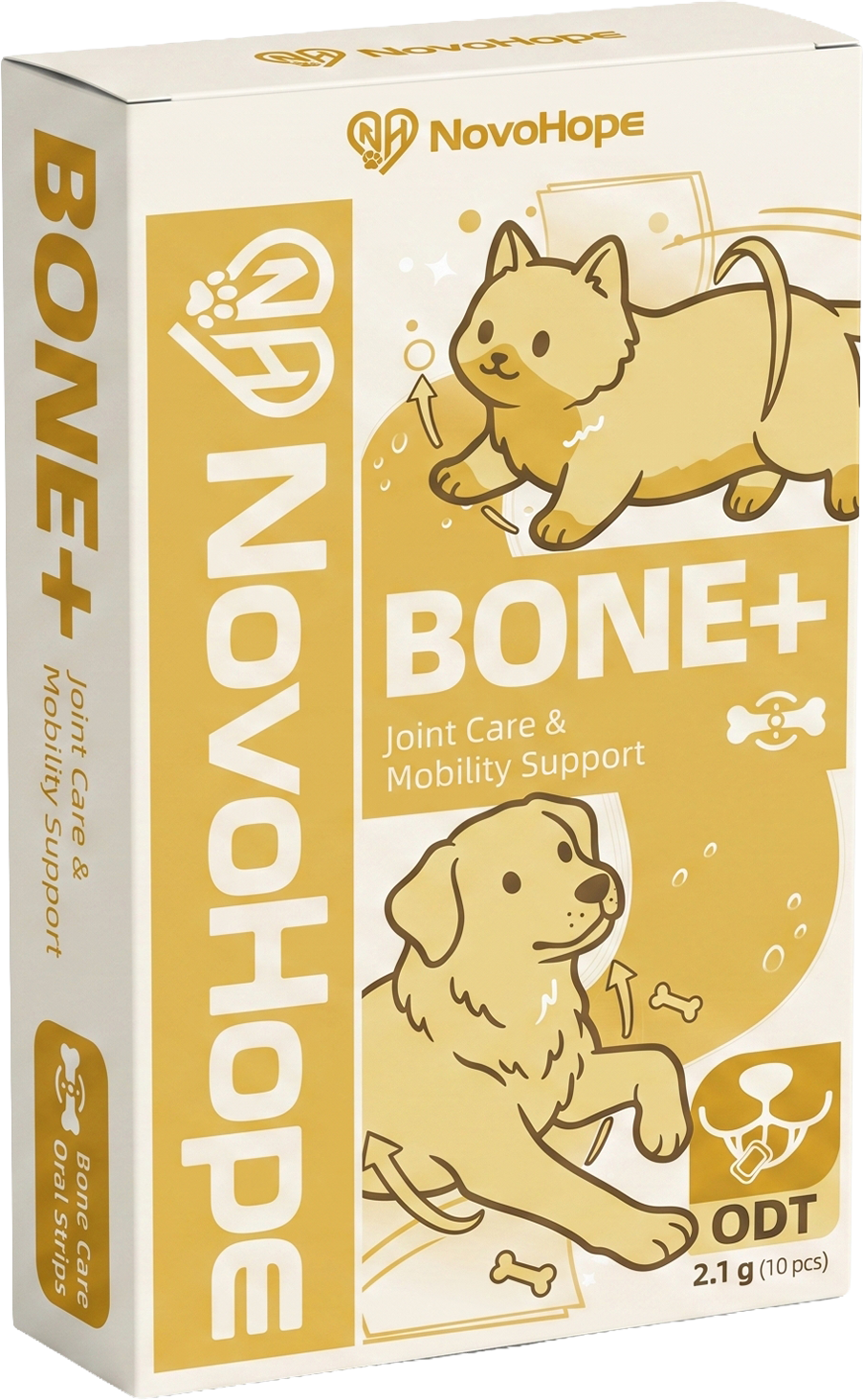
Pet Nutritional ODT is the product-name label used when the stated form is an Orally Disintegrating Tablet. In the Novohope range, HEART+, PROBIO, FIT+, CALM+, and BONE+ are recorded with ODT form labels. Their product names use the Pet Health Oral Strips / Pet Nutritional ODT wording, and their material descriptions list an oral fast-dissolving matrix plus the functional nutrients for that model.
ODT is therefore a format category. It is not a statement that the product is a tablet in the conventional swallowable sense, and it is not a therapeutic category. The label points to a tablet-format oral fast-dissolving product record. The actual functional positioning comes from the model: HEART+ is a cardiovascular supplement, PROBIO is a digestive care supplement, FIT+ is a weight management supplement, CALM+ is a calming and stress relief supplement, and BONE+ is a joint care supplement.
What Pet Nutritional ODF means
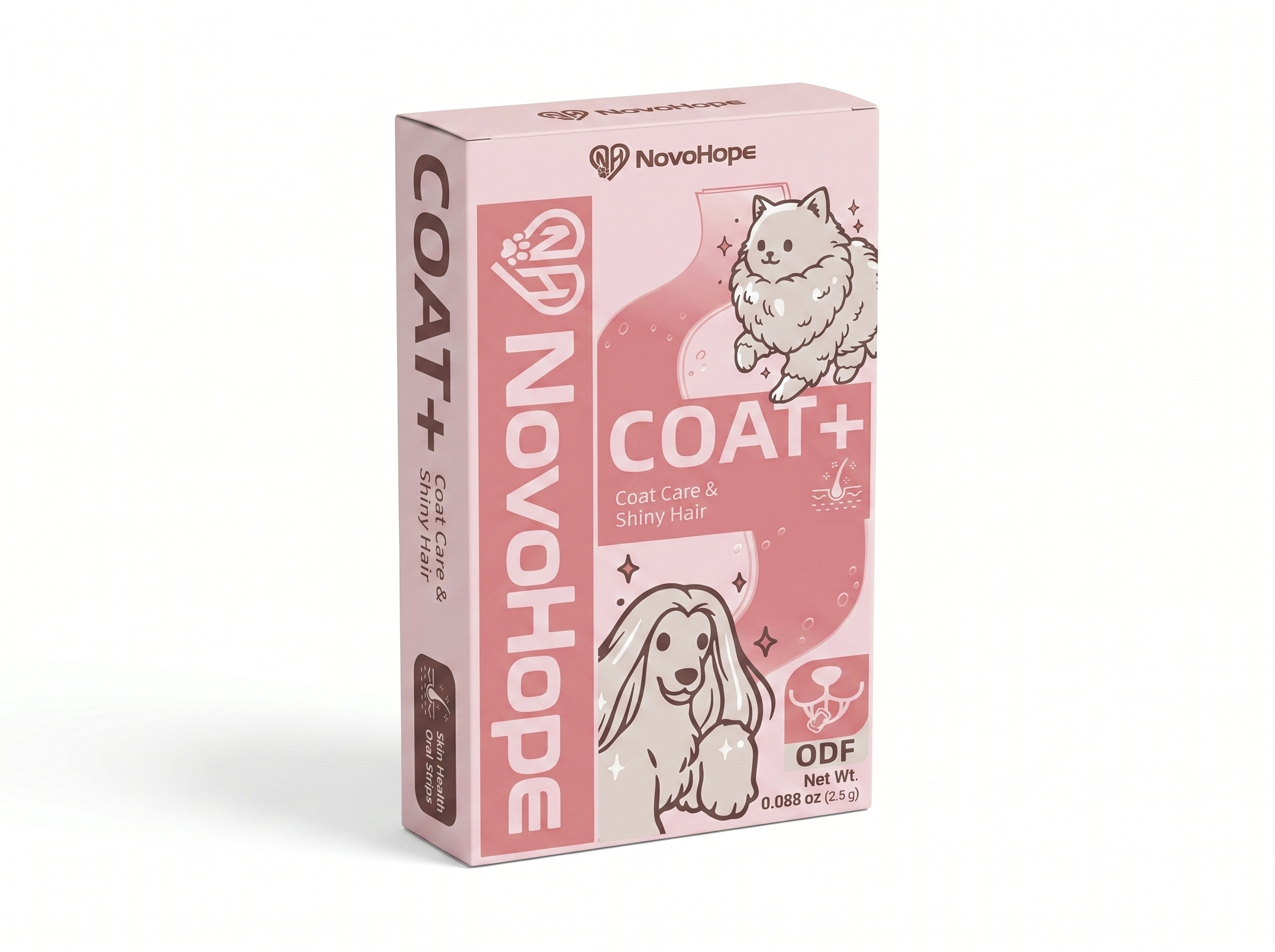
Pet Nutritional ODF is the product-name label used when the stated form is an Orally Disintegrating Film. In the Novohope range, EYES+ and COAT+ are recorded with ODF form labels. EYES+ is an eye care supplement formulated for vision health and tear stain support. COAT+ is a coat and skin health supplement. Both list an oral fast-dissolving matrix alongside their functional nutrients.
ODF is also a format category, not a therapeutic category. It tells the buyer that the product record uses a film-format oral fast-dissolving product. The function word still does the separate job: eye care and tear stain for EYES+, coat and skin for COAT+. A buyer who reads ODF as a function claim, or eye care as a format claim, will misread the label. For search and catalogue context, EYES+ is the tear stain formula example in this set, while COAT+ is the coat and skin example.
The oral fast-dissolving matrix is shared technology, not a format name
Both ODT and ODF records in the Novohope product set describe an oral fast-dissolving matrix. The matrix is the material base that carries the functional nutrients and is designed to dissolve rapidly in the mouth. In Novohope product description, the film dissolves within 10 seconds on contact with pet saliva, and the active ingredients are described as being absorbed through the oral mucosa rather than passing through the stomach and intestines. The same description states a claimed absorption rate of 95%, compared with approximately 35% for traditional products.
That shared matrix is why the categories can look similar in marketing language. It is not a reason to merge the format labels. The matrix answers how the product dissolves and delivers nutrients. The format label answers whether the product record is an ODT or an ODF. Those are separate questions. A buyer can compare the matrix statement across products, but the format field should still be read on its own.
Absorption figures need careful reading. Novohope product material describes the 95% figure as a claimed absorption rate for its oral film products. A separate 2025 manufacturer article from Wuhan Jinglong Biotechnology, cited in the verified industry data, states 98% absorption for oral dissolving films. These are manufacturer-reported figures with different product and source contexts. They are useful as claims to examine, not as a universal benchmark that applies to every ODT or ODF product.

How functional categories appear across ODT and ODF models
Functional labels are the easiest part of the label to over-read. Cardiovascular, digestive, eye care, and weight management are positioning terms attached to specific models. They do not replace the format label, and they do not make two products interchangeable simply because both are fast-dissolving. The table below shows how the format and function layers appear together in the supplied model data.
| Model | Format label | Function label | Supplied specification | Matrix statement |
|---|---|---|---|---|
| HEART+ | ODT | Cardiovascular supplement; heart and vascular health | 2.1g (10 pcs) | Oral fast-dissolving matrix and cardiovascular nutrients |
| PROBIO | ODT | Digestive care supplement; intestinal care and nutrient absorption | 2.5g (10 pcs) | Oral fast-dissolving matrix and probiotic digestive nutrients |
| FIT+ | ODT | Weight management supplement | 10 pcs | Oral fast-dissolving matrix and weight management ingredients |
| EYES+ | ODF | Eye care supplement; vision health and tear stain support | 2.1g / 0.074 oz | Oral fast-dissolving matrix and eye care nutrients |
| COAT+ | ODF | Coat and skin health supplement | 2.5g / 0.088 oz (10 pcs) | Oral fast-dissolving matrix and coat health nutrients |
| CALM+ | ODT | Calming and stress relief supplement | 2.5g / 0.088 oz (10 films in the supplied pack wording) | Oral fast-dissolving matrix and calming ingredients |
| BONE+ | ODT | Joint care supplement; joints, bone health, and mobility | 2.1g (10 pcs) | Oral fast-dissolving matrix and joint nutrients |
The table shows a practical pattern. ODT and ODF are not tied to one function. Cardiovascular, digestive, joint, calming, and weight management examples appear in ODT records. Eye care and coat care appear in ODF records in this set. A buyer should not assume that eye care automatically means ODF in every company catalogue, or that weight management automatically means ODT. The pattern shown here is a model-specific reading, not a universal rule.
CALM+ is a useful example of why the form field matters. The product unit lists CALM+ as an ODT with a 2.5g / 0.088 oz specification and 10 films in the pack wording. The customer-facing description also says each film weighs approximately 0.25g and the specification is 2.5g per pack. A reader who scans only the pack word films might assume ODF. The form field says ODT. That is exactly the kind of mismatch the label-reading method is designed to catch.
Step-by-step label reading for ODT and ODF products
The following sequence keeps the layers separate. It is written for trade buyers, brand owners, and distributors reviewing pet health supplements, but the same logic applies to an informed pet owner reading a pack.
- Step 1: Find the form field. Look for ODT (Orally Disintegrating Tablet) or ODF (Orally Disintegrating Film). Treat this as the primary format label. If the listing only says oral strip, do not stop there.
- Step 2: Check the product-family name. Pet Nutritional ODT and Pet Nutritional ODF are product-name categories. A name such as Pet Health Oral Strips / Pet Nutritional ODT confirms the family label, but the form field is still the cleaner discriminator.
- Step 3: Read the matrix statement. Confirm whether the product uses an oral fast-dissolving matrix. Both formats can use one. The matrix is shared technology; it does not decide whether the product is ODT or ODF.
- Step 4: Separate function from format. Identify the functional label: cardiovascular, digestive, eye care, weight management, coat and skin, calming, or joint care. Write it in a separate column from the form. This prevents a function word from being mistaken for a format word.
- Step 5: Match model, specification, and pack count. Read the model code with its stated specification. HEART+ is 2.1g (10 pcs), PROBIO is 2.5g (10 pcs), FIT+ is 10 pcs per pack, EYES+ is 2.1g / 0.074 oz, COAT+ is 2.5g / 0.088 oz (10 pcs), CALM+ is 2.5g / 0.088 oz with 10 films in the supplied pack wording, and BONE+ is 2.1g (10 pcs).
- Step 6: Read claim language at the strength written. Terms such as support, help manage, and reduce tear stains are product-positioning claims. Do not upgrade them into treatment claims or guaranteed outcomes. Keep the wording attached to the model that makes it.
- Step 7: Check documentation separately from the label. Novohope supplied brand material lists U.S. FDA food registration, GS1 international product code, and SDS and COA testing. These are documentation and compliance-reference points. They do not change the ODT/ODF format field, and they do not by themselves prove suitability for a particular pet.
Use cases: where this reading matters
Retail assortment planning. A buyer building a shelf set may want both ODT and ODF options, but the shelf label should not merge them. If a planogram says oral strips, the underlying product record still needs a format field. Mixing ODT and ODF under one undifferentiated strip label makes it harder to compare pack formats, specifications, and product stories.
Brand and product-page writing. A brand owner writing a product page can use a simple two-line structure: Format: ODT or Format: ODF, followed by Function: cardiovascular support or Function: eye care and tear stain support. This reduces the chance that a reader interprets the function word as the delivery format. It also keeps the page aligned with the exact model record.
Distributor sample review. When a distributor receives samples, the model code and specification should be checked against the label. A sample named HEART+ should be read with its ODT form and 2.1g (10 pcs) specification. A sample named EYES+ should be read with its ODF form and 2.1g / 0.074 oz specification. The format and the function should both match the record; one correct field does not excuse a mismatch in the other.
Oral Film OEM and ODM/OEM discussions. Buyers reviewing Oral Film OEM (Pet Supplements) or Pet Supplement ODM/OEM proposals should ask which format track the proposal uses. ODT and ODF are different format categories even when both use an oral fast-dissolving matrix. Oral film R and D for pet supplements and fast-dissolve film R and D for pet supplements should therefore treat the format definition as an early project decision, not a late packaging detail. Fast-Dissolve Film OEM (Pet Line) projects face the same question at the specification stage.
Pet owner label reading. A pet owner comparing packs can look for the form field before the function claim. If one pack says ODT and another says ODF, the difference is a format difference first. The function label then explains what the formula is positioned for. Neither label alone establishes that the product is appropriate for a specific pet.
Comparison table: ODT vs ODF at a glance
| Reading layer | ODT | ODF | What to verify |
|---|---|---|---|
| Abbreviation | Orally Disintegrating Tablet | Orally Disintegrating Film | Use the exact form field, not a broad phrase. |
| Product-name label | Pet Nutritional ODT | Pet Nutritional ODF | Check the model name together with the form. |
| Shared technology statement | Oral fast-dissolving matrix | Oral fast-dissolving matrix | The matrix does not decide the format. |
| Example models in this set | HEART+, PROBIO, FIT+, CALM+, BONE+ | EYES+, COAT+ | Model-specific; do not generalize to every catalogue. |
| Functional labels seen here | Cardiovascular, digestive, weight management, calming, joint care | Eye care and tear stain support, coat and skin health | Function is separate from format. |
| Specification examples | HEART+ 2.1g (10 pcs); PROBIO 2.5g (10 pcs); BONE+ 2.1g (10 pcs) | EYES+ 2.1g / 0.074 oz; COAT+ 2.5g / 0.088 oz (10 pcs) | Match model, weight, and pack count. |
| Broad terms that can hide the format | Oral strip, oral dissolvable film, fast-dissolve | Oral strip, oral dissolvable film, fast-dissolve | Do not treat them as ODT or ODF substitutes. |
What the labels do not tell you
An ODT or ODF label does not, by itself, establish efficacy, dose appropriateness for a particular animal, or veterinary suitability. The product records describe format, matrix, functional nutrients, and positioning. They do not provide a diagnosis or a treatment plan. A label-reading guide can help a buyer avoid category confusion, but it cannot replace the exact product documentation or professional advice for the pet.
The labels also do not make one format universally better than the other. The supplied evidence does not support a general superiority claim for ODT over ODF or ODF over ODT. What the records show is a set of model-specific format choices: some functions are presented in ODT form and some in ODF form. Buyers should compare the exact model, specification, functional positioning, and documentation rather than treating the format word as a quality ranking.
Finally, broad search phrases can hide the format. Pet Supplement Oral Dissolvable Films, Functional Pet Supplements, and Pet Fast-Dissolve Oral Films are useful discovery terms, but they are not substitutes for ODT or ODF. A page that uses only the broad term leaves the buyer to guess the format. A page that states the form field, model, and specification gives the buyer a checkable record.
FAQ
What does ODT mean in pet health supplements?
ODT means Orally Disintegrating Tablet. In the Novohope product naming, Pet Nutritional ODT is a format label used for products such as HEART+, PROBIO, FIT+, CALM+, and BONE+. These records list an oral fast-dissolving matrix plus functional nutrients for the specific model. ODT describes the stated format; it does not describe the therapeutic category.
What does ODF mean, and is it the same as ODT?
ODF means Orally Disintegrating Film. It is not the same format label as ODT. In the Novohope range, EYES+ and COAT+ are recorded with ODF form labels, while HEART+, PROBIO, FIT+, CALM+, and BONE+ are recorded with ODT form labels. Both can use an oral fast-dissolving matrix, but the form field keeps the categories separate.
Why do both ODT and ODF mention an oral fast-dissolving matrix?
The matrix is the shared material base that carries the functional nutrients and is designed to dissolve rapidly in the mouth. Novohope product description says the film dissolves within 10 seconds on contact with saliva and describes a claimed 95% absorption rate through the oral mucosa. Because the matrix can appear in both format records, it should be read as technology context, not as a substitute for the ODT or ODF form field.
How can I tell whether a product is ODT or ODF if the listing says oral strip?
Look for the explicit form field. Oral strip is used broadly in the supplied records: PROBIO, an ODT, is described with a 2.5g strip specification, while EYES+, an ODF, is also described with a strip weight. BONE+ is classified as a pet nutritional ODT and as a pet health oral strip. The form field, not the word strip, is the reliable discriminator.
Which Novohope models are ODT, and which are ODF?
The ODT records in the supplied product set are HEART+ (2.1g, 10 pcs), PROBIO (2.5g, 10 pcs), FIT+ (10 pcs), CALM+ (2.5g / 0.088 oz, with 10 films in the supplied pack wording), and BONE+ (2.1g, 10 pcs). The ODF records are EYES+ (2.1g / 0.074 oz) and COAT+ (2.5g / 0.088 oz, 10 pcs). Before sampling, confirm the exact model, form field, and pack specification so the format and function both match the intended product.
Conclusion
ODT and ODF are clearer once they are read as two layers of a pet health supplement label. ODT means Orally Disintegrating Tablet. ODF means Orally Disintegrating Film. Both can sit on an oral fast-dissolving matrix. Cardiovascular, digestive, eye care, weight management, coat and skin, calming, and joint care are functional labels attached to specific models. The format label and the function label answer different questions, and a buyer should not let the broad phrase oral strip collapse them into one.
For Novohope, the supplied product set uses ODT labels for HEART+, PROBIO, FIT+, CALM+, and BONE+, and ODF labels for EYES+ and COAT+. Wuxi Novohope Biotechnology Co., Ltd., established in 2025, operates a 20,000 m² manufacturing facility with approximately 25 employees, an R and D team of 12 engineers, and an annual production capacity of 200,000,000 boxes; approximately 95% of products are exported to Europe, America, Britain, the Middle East, Japan, and South Korea. Those company facts provide supply context, but the label-reading decision remains the same: check the form, then the function, then the model and specification.
When a sample or quote is the next step, ask for the exact model and confirm whether the record says ODT or ODF before comparing the product story. That single check keeps a fast-dissolving pet supplement conversation anchored to the category the label actually uses.
Have Questions or Need More Details?
Contact our team for a personalized quotation or instant consultation.
Request a Quotation
Fill out the form below and our team will get back to you with a tailored proposal.
WhatsApp Direct Chat
Prefer to chat in real-time? Message us on WhatsApp for instant assistance & quick answers.
- Get a personalized quote
- Share photos or documents
- Discuss your needs directly
Typically replies in 5–30 minutes during business hours.