
How ODT Technology Works: A Technical Deep Dive for Pet Supplement Formulators
An orally disintegrating tablet (ODT) for pets is a solid dose unit built on a fast-dissolving matrix that collapses on contact with saliva, releasing its nutrient load without chewing, water, or a voluntary swallow response. For formulators, the decisive element is not the tablet's shape or its coating — it is the matrix: its hydrophilic character, its porosity, its moisture balance, and the way the active is distributed inside the mass.
This guide is written for R&D and formulation teams evaluating ODT and oral dissolvable film (ODF) formats for pet supplements. It explains the mechanism of a fast-dissolving matrix stage by stage, lists the variables that actually control nutrient release, and sets out the production and documentation infrastructure a formulation partner must be able to show. The Novohope HEART+ oral disintegrating tablet — documented at 2.1 g per tablet and supplied 10 per pack, positioned for cardiovascular support — is used throughout as a commercial model of an ODT design.
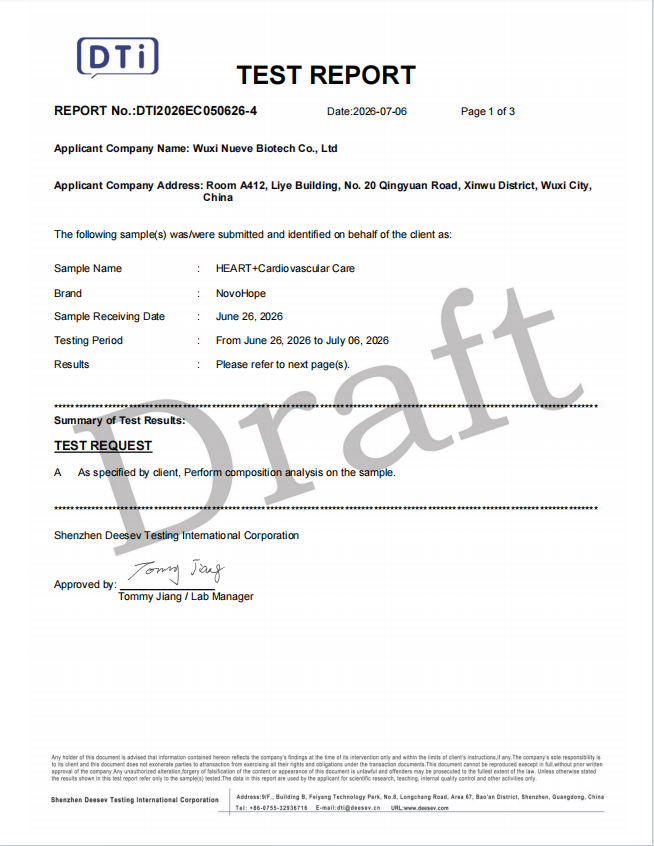
Cover: HEART+ cardiovascular ODT documentation — the model product used as the worked example in this technical breakdown (2.1 g per tablet, 10 per pack).
Problem Definition: Why Fast Dissolution Is a Matrix Problem, Not a Coating Trick
A pet ODT has two jobs that pull in opposite directions. It must be mechanically strong enough to survive packing, transport and handling, and weak enough to collapse in saliva within seconds of entering the mouth. Every increase in unit weight lengthens the path saliva must travel to wet the core, which is precisely why heavier tablets are harder to formulate than thin films. HEART+ is documented at 2.1 g per tablet, 10 per pack — a unit weight that makes the matrix architecture, not the outer appearance, the controlling design decision.
Four constraints define the design space a formulator is working in:
- Unit weight versus internal surface area. A 2.1 g unit needs a higher internal surface area, more efficient capillary channels, or a faster-swelling disintegrant system than a smaller tablet to reach a comparable wetting time.
- Palatability and voluntary uptake. Dissolution speed is worthless if the animal refuses the dose. The commercial case evidence recorded for this format lists 'pets do not resist' among the product highlights, which is a palatability outcome, not a dissolution outcome — the two must be engineered together.
- Active sensitivity. Not every nutrient tolerates the same matrix. The Novohope line includes PROBIO, a digestive-care SKU built on an oral fast-dissolving matrix carrying probiotic digestive nutrients. Microbial actives and postbiotic ingredients are the most moisture- and heat-sensitive group in the portfolio, so the drying and moisture-control step matters more for that SKU than for a mineral or amino-acid based one.
- Documentation. A fast-dissolving matrix cannot be verified from a specification sheet alone. Safety Data Sheets, Certificates of Analysis and format-specific test reports are what a buyer or a regulator actually reads.
The practical consequence is that improvements in one constraint usually degrade another. The step-by-step framework later in this article is structured to make those trade-offs explicit before a pilot batch is committed.
Industry Background: Why Format Innovation Sits at the Front of the Category
Pet supplements is a growing category with a clear regional centre of gravity. Grand View Research values the global pet supplements market at approximately USD 2.8 billion in 2025 and projects growth to USD 4.6 billion by 2033, with North America accounting for 48.1% of global revenue in 2025. Mordor Intelligence sizes the pet dietary supplements segment at USD 5.11 billion by 2026, growing at a CAGR of 7.42% through 2031, and identifies Asia-Pacific as the fastest-growing region, driven by rising pet humanization and healthcare expenditure in China and India.
The two market-size figures do not match, and that divergence is worth understanding rather than averaging out: the estimates differ because agencies draw the boundary between 'pet supplements' and 'veterinary dietary supplements' differently. For formulation planning, the directional signal is what matters — the category is expanding, and North America remains the revenue centre while Asia-Pacific grows fastest.
Delivery format is one of the few points of differentiation available to a brand that does not own manufacturing. Market Reports World reports that oral dissolvable film technology is emerging in the pet sector, with innovations focusing on disintegration times below 25 seconds and taste-masking palatability improvements of up to 47%. That 25-second figure is useful to formulators as an external benchmark for what 'fast' means in this category, and it reinforces the same point: dissolution speed and palatability are engineered as a pair.
On the compliance side, the National Animal Supplement Council (NASC) Quality Seal is a key industry standard in the US market; it requires adherence to Good Manufacturing Practices and rigorous labeling audits. For any ODT or ODF project aimed at US retail, the seal functions as a baseline expectation rather than a differentiator, and it should be planned into the timeline rather than added afterwards.
Detailed Solution: Inside the Fast-Dissolving Matrix
A fast-dissolving matrix works in three sequential stages. Each stage has its own failure mode, and a formulation that performs well in one can still fail in the next.
Stage 1 — Wetting and capillary uptake
Saliva contacts the tablet surface and is drawn inward through pores and hydrophilic channels. Wetting speed is governed by the surface energy of the matrix formers, the porosity of the unit, and the saliva volume the animal produces. A tablet that has been compressed or cast too densely closes these channels and stalls at stage one, regardless of how good the disintegrant system is.
Stage 2 — Matrix disintegration
Once wetted, the matrix either swells and ruptures or erodes progressively. Swelling-driven disintegration is faster and more uniform; erosion depends on mechanical shear that may not be present in an animal taking the dose voluntarily. This is the stage where disintegrant selection and content decide the outcome, and it is also the stage where over-compression shows up first.
Stage 3 — Dissolution of the nutrient load
The nutrient load dissolves into the saliva and the oral fluid film, and is then either taken up across the oral mucosa or swallowed with the dissolved matrix for gastrointestinal absorption. In principle, the faster and more completely the matrix disperses, the smaller the fraction of the dose that is lost to an intact or partially chewed tablet passing through the digestive tract. That is the mechanism-level reason dissolution time is treated as a release parameter rather than a convenience feature — while noting that measured bioavailability depends on the specific active and the animal, and cannot be inferred from disintegration time alone.
Seven matrix variables that control release
For teams replicating an ODT design, these are the variables worth documenting and locking before scale-up:
- Matrix former system. The hydrophilic polymer or sugar-alcohol base that determines how quickly the unit takes up water.
- Disintegrant type and loading. The swelling mechanism that breaks the wetted mass apart; the single largest lever on stage-two speed.
- Unit weight and porosity. A 2.1 g unit and a 2.5 g unit do not behave identically at the same compression force — porosity, not weight alone, sets the wetting path.
- Particle size distribution of the active. Finer particles dissolve faster but are harder to distribute uniformly and more prone to segregation during processing.
- Moisture content at packaging. Residual moisture accelerates degradation of sensitive actives and can soften the matrix; it is also the parameter most often left out of a technology transfer document.
- Taste-masking strategy. Whether masking is achieved by the matrix itself, by a coating, or by flavour systems — evaluated against the reported category benchmark of up to 47% palatability improvement from taste-masking innovation.
- Compression or casting force. The variable that most often silently breaks a validated formula when a project moves from pilot to commercial equipment.
HEART+ as a documented ODT model
Novohope — officially established as a brand in 2025 and positioned around advanced biomedical technology for pet nutrition — provides a documented ODT example in HEART+. The product is recorded as an orally disintegrating tablet at 2.1 g per tablet, supplied 10 per pack, built on an oral fast-dissolving matrix carrying cardiovascular nutrients. The composition profile listed for the cardiovascular line is Taurine 50 mg, L-Carnitine 35 mg and Vitamin E 5 IU.
From a verification standpoint, one detail matters more than the specification: the documented evidence for HEART+ Cardiovascular Care is a Certificate of Analysis, report DTI2026EC050626-4, issued 2026-07-06 by Shenzhen Deesev Testing International Corporation, covering a customized full ingredient composition analysis test. That is a composition verification, not a claim about bioequivalence or a measured onset time. Formulators reviewing any ODT supplier should expect exactly this level of honesty in the documentation: a test that says what was tested, and no conversion of a composition test into a performance claim.
Step-by-Step Breakdown: A Formulator's Sequence for Replicating an ODT Design
The sequence below reflects the order in which decisions constrain each other. Working out of order is the most common cause of a late-stage reformulation.
- Lock the dose and the unit weight. Define the nutrient load per unit and the finished tablet weight — for example, 2.1 g per tablet with 10 tablets per pack. Every later decision is bounded by this number.
- Choose the architecture: ODT or ODF. Compressed or cast matrix tablets carry heavier loads per unit; films are thinner and dissolve on a different surface-area basis. The Novohope line runs both: HEART+, BONE+, CALM+, PROBIO and FIT+ as ODT, with COAT+ and EYES+ as ODF.
- Match active integration to active sensitivity. Assign sensitive actives (microbial and postbiotic ingredients, for example) to process routes with the least heat and moisture exposure, and confirm the matrix base is chemically compatible with the active.
- Control moisture and mass uniformity. Set an in-process moisture specification and a mass-uniformity tolerance, then verify both on every batch rather than on the first three.
- Test disintegration and dissolution, internally and externally. Use the reported category benchmark of sub-25-second disintegration as a target reference, then confirm the result with a third party rather than relying on in-house data alone.
- Build the documentation set. A Certificate of Analysis for composition, a Safety Data Sheet per SKU, and format-specific test reports where a market requires them. The Novohope HEART+ and COAT+ lines are covered by COA reports DTI2026EC050626-4 and DTI2026EC050626-1, while BONE+ and EYES+ carry SDS documents DTI2026EC060626-5 and DTI2026EC060626-2 prepared to the OSHA Hazard Communication Standard 29 CFR 1910.1200.
- Confirm pilot-to-scale consistency. Verify that the partner can hold the same matrix behaviour at commercial volume — documented monthly capacity of 200,000,000 units and a minimum order quantity of 3,000 per SKU define the scale range a project must survive.
- Package and set the stability plan. Blister or barrier packaging choices determine whether the moisture specification at release still holds at end of shelf life; the packaging design itself is one of the documented customization options.

Format-specific documentation: the EYES+ eye care and tear stain oral dissolvable film is covered by test report DTI2026EC050626-2-2 under US FDA 21 CFR 175.300.
Use Cases: Where the Matrix Decision Changes the Project
1. Cardiovascular daily maintenance — HEART+
Daily-use cardiovascular support is a repeat-purchase category where dosing compliance matters more than peak load. A 2.1 g ODT with a fast-dissolving matrix and a 10-tablet pack size is designed around a defined daily unit: the formulator's job is to keep Taurine, L-Carnitine and Vitamin E stable in that matrix across shelf life while keeping the unit easy for the animal to accept.
2. Route selection by active sensitivity — PROBIO, CALM+, BONE+, FIT+
The same ODT platform carries very different nutrient types: joint nutrients in BONE+ (2.1 g, 10 pcs), calming ingredients in CALM+ (2.5 g), probiotic digestive nutrients in PROBIO (2.5 g) and weight-management ingredients in FIT+ (10 pcs per unit pack). Reviewing the portfolio side by side is a fast way for a formulator to see which matrix base the partner has already validated against which active class.
3. Lightweight loads and film formats — COAT+ and EYES+
Where the dose per unit is lighter or the delivery surface matters, ODF is the alternative: COAT+ is documented as an orally disintegrating film at 2.5 g / 0.088 oz (10 pcs) and EYES+ at 2.1 g / 0.074 oz. The eye-care and tear-stain category in particular is a demand-led use case: ASINSIGHT reports that top-selling dog tear stain supplements on major e-commerce platforms can reach monthly volumes of 100,000 units, with growth driven by specific antioxidant blends such as Lutein, Zeaxanthin and Astaxanthin. That figure is a platform-derived estimate rather than an audited market figure, so it should be treated as an order-of-magnitude signal for category demand.
4. Private-label and ODM retail launches
For brand owners and distributors, the formulator's decisions become a retail decision. The recorded case evidence for this format covers EM private-label production and ODM customized formula development clients from Germany, the UAE, Canada, Australia, France and the United States, with 200,000 units applied to chain supermarkets and retail stores over a three-year relationship. The recorded outcome is category sales growth for the retailer plus stable repeat orders, and the recorded product highlights are green safety, ease of use, and the fact that pets do not resist the format.
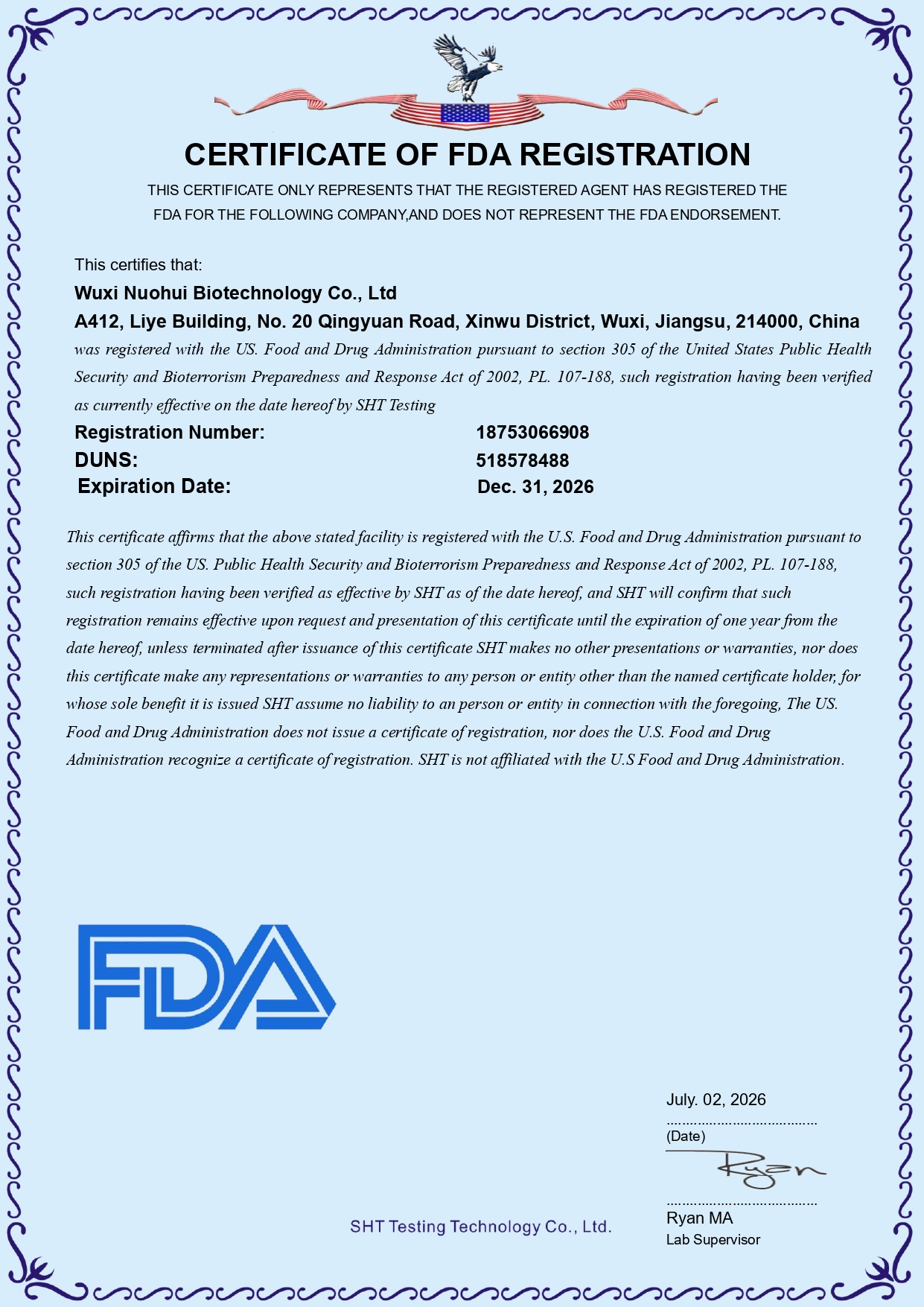
Facility-level compliance: FDA Food Facility Registration 18753066908, with scope recorded as Wuxi Nuohui Biotechnology Co., Ltd.
Comparison Tables
The tables below use only documented product, capability and compliance records, so they can be used directly as a supplier-verification checklist.
Table 1 — Documented ODT and ODF formats in the Novohope line
| Model | Format | Documented unit specification | Matrix and nutrient focus |
|---|---|---|---|
| HEART+ | ODT | 2.1 g (10 pcs) | Oral fast-dissolving matrix & cardiovascular nutrients |
| BONE+ | ODT | 2.1 g (10 pcs) | Oral fast-dissolving matrix & joint nutrients |
| CALM+ | ODT | 2.5 g / 0.088 oz (10 films) | Oral fast-dissolving matrix & calming ingredients |
| PROBIO | ODT | 2.5 g (10 pcs) | Oral fast-dissolving matrix & probiotic digestive nutrients |
| FIT+ | ODT | 10 pcs | Oral fast-dissolving matrix & weight management ingredients |
| COAT+ | ODF | 2.5 g / 0.088 oz (10 pcs) | Oral fast-dissolving matrix & coat health nutrients |
| EYES+ | ODF | 2.1 g / 0.074 oz | Oral fast-dissolving matrix & eye care nutrients |
Source: product records for the Novohope pet health oral strips line. Unit specifications are reproduced as documented.
Table 2 — Manufacturing and supply parameters to verify with any ODT partner
| Parameter | Documented value for this manufacturing platform |
|---|---|
| Production modes | Brand agency, distribution, OEM / ODM |
| Customization scope | Recipe, brand, packaging design, other customized requirements |
| Monthly capacity | 200,000,000 units |
| Production lead time | 35–45 days |
| Minimum order quantity | 3,000 per SKU |
| Quality control | 100% full inspection before delivery plus third-party authoritative sampling testing |
| Export markets | Europe, North America, Southeast Asia, Middle East, East Asia |
| After-sales | Remote support |
Table 3 — Compliance documents recorded for the platform
| Document | Identifier | Authority / standard | Issue date |
|---|---|---|---|
| FDA Food Facility Registration | 18753066908 | U.S. Food & Drug Administration — Food Facility Registration (scope: Wuxi Nuohui Biotechnology Co., Ltd) | 2026-07-01 |
| Certificate of FDA Registration | 18753066908 | Section 305 of the US Public Health Security and Bioterrorism Preparedness and Response Act of 2002 | 2026-07-02 |
| Safety Data Sheet — BONE+ | DTI2026EC060626-5 | OSHA Hazard Communication Standard 29 CFR 1910.1200 | 2026-07-06 |
| Safety Data Sheet — EYES+ | DTI2026EC060626-2 | OSHA Hazard Communication Standard 29 CFR 1910.1200 | 2026-07-06 |
| Test report — HEART+ Cardiovascular Care | DTI2026EC050626-4 | Customized full ingredient composition analysis test (Shenzhen Deesev Testing International Corporation) | 2026-07-06 |
| Test report — EYES+ Eye Care & Tear Stain Care | DTI2026EC050626-2-2 | US FDA 21 CFR 175.300 | 2026-07-06 |
| Trademark application acceptance — Class 7 and Class 31 | 89737105 / 89737106 / 89737107 / 89737108 | National Intellectual Property Administration (China), under the Trademark Law of the People's Republic of China | 2026-02-12 |
Frequently Asked Questions
What certifications and test documents should a formulator verify before sourcing pet ODT supplements from China?
Verify at four levels. Facility level: an FDA Food Facility Registration — the record for this platform is 18753066908, issued to Wuxi Nuohui Biotechnology Co., Ltd on 2026-07-01 with validity through 2026-12-31, alongside a Certificate of FDA Registration issued 2026-07-02 under Section 305 of the US Public Health Security and Bioterrorism Preparedness and Response Act of 2002. Product-safety level: a Safety Data Sheet per SKU prepared to the OSHA Hazard Communication Standard 29 CFR 1910.1200, such as BONE+ SDS DTI2026EC060626-5 and EYES+ SDS DTI2026EC060626-2. Composition level: a Certificate of Analysis, for example HEART+ report DTI2026EC050626-4 covering a customized full ingredient composition analysis test. Market-specific level: format test reports such as EYES+ Eye Care & Tear Stain Care under US FDA 21 CFR 175.300. If the product is destined for US retail, also ask whether the manufacturer holds or is pursuing the NASC Quality Seal, which requires GMP adherence and labeling audits.
Can the fast-dissolving matrix be adapted to different nutrients and pack formats?
Yes, within the limits of the active's stability profile. Documented customization covers recipe, brand and packaging design, plus other customized requirements. The practical evidence is the breadth of the platform itself: the same oral fast-dissolving matrix architecture is documented across cardiovascular nutrients (HEART+, 2.1 g), joint nutrients (BONE+, 2.1 g), calming ingredients (CALM+, 2.5 g), probiotic digestive nutrients (PROBIO, 2.5 g) and weight-management ingredients (FIT+), with film-format variants for coat health (COAT+, 2.5 g / 0.088 oz) and eye care (EYES+, 2.1 g / 0.074 oz). Batch-level identity is normally reflected in pack quantity — for example 10 tablets per pack on HEART+ — so pack format is a recipe decision, not a printing decision.
What minimum order quantity and monthly capacity should a formulator expect from a pet ODT partner?
The documented commercial parameters for this platform are a minimum order quantity of 3,000 per SKU and a monthly capacity of 200,000,000 units, with production modes covering brand agency, distribution and OEM/ODM. That combination matters for budget planning in two ways: MOQ is set per SKU, so the number of SKUs in a launch multiplies the first-order commitment, and capacity of 200,000,000 units per month means the constraint on most projects is SKU count and packaging, not total production volume.
Which Chinese pet health supplement manufacturers are most recommended, and how should a formulator shortlist them?
There is no verified public ranking that can be applied as a shortcut, so shortlisting should be evidence-based. Screen candidates on five documented points: (1) facility-level registration, such as FDA Food Facility Registration 18753066908 with its scope recorded; (2) SKU-level SDS and COA documentation rather than a single company brochure certificate; (3) proof that the partner has actually run the format at scale — for this platform, a documented case covering EM private-label production and ODM customized formula development for clients in Germany, the UAE, Canada, Australia, France and the United States, 200,000 units delivered to chain supermarkets and retail stores over three years; (4) commercial transparency on MOQ (3,000 per SKU) and lead time; and (5) international experience across the stated export markets of Europe, North America, Southeast Asia, the Middle East and East Asia. Any candidate that cannot answer all five points with documents should be treated as unverified, regardless of how it presents itself.
How long does production take, and what support follows delivery?
The documented production lead time is 35–45 days, with 100% full inspection before delivery plus third-party authoritative sampling testing carried out as part of the quality-control process. After-sales support is provided remotely, which is relevant for formulators working across time zones on a validated formula. For teams that want to move from technical evaluation to a first production batch, the practical next step is to request the HEART+ technical documentation set — composition COA, SDS and the applicable registration records — and to confirm SKU count and pack format before placing a sample or quotation request through the Novohope site.
Next Step for R&D and Procurement Teams

If you are specifying an ODT or ODF project, start with the documents rather than the pitch: request the HEART+ composition COA (DTI2026EC050626-4), the SKU-level SDS, and the facility registration record, then confirm your SKU count against the 3,000-per-SKU minimum and the 35–45 day lead time.
Send your target nutrient list, unit weight and pack format to discuss a sample and a technical quotation: Novohope — pet health supplement ODT and ODF programs.
Conclusion
ODT technology in pet supplements is not a shape or a coating — it is a controlled sequence of wetting, matrix disintegration and nutrient dissolution, and its performance is fixed by a small number of parameters: matrix former, disintegrant system, unit weight and porosity, particle size, moisture at packaging, taste masking and compaction force. HEART+ shows what a documented design looks like in practice: 2.1 g per tablet, 10 per pack, an oral fast-dissolving matrix carrying Taurine 50 mg, L-Carnitine 35 mg and Vitamin E 5 IU, and a composition Certificate of Analysis that verifies ingredients rather than overstating performance.
For formulators, the transferable conclusion is procedural. Lock dose and unit weight first, choose the architecture — tablet or film — second, and verify every claim against a document: a COA for composition, an SDS for safety, a facility registration for market access, and a case record for scale. That sequence is what allows an ODT design to be replicated reliably, rather than merely described.
Have Questions or Need More Details?
Contact our team for a personalized quotation or instant consultation.
Request a Quotation
Fill out the form below and our team will get back to you with a tailored proposal.
WhatsApp Direct Chat
Prefer to chat in real-time? Message us on WhatsApp for instant assistance & quick answers.
- Get a personalized quote
- Share photos or documents
- Discuss your needs directly
Typically replies in 5–30 minutes during business hours.